There's music in almost every shop I walk into. Not because music enhances the experience for everyone, because research says it increases dwell time and spend. The music is a marketing strategy. And somewhere inside that calculus, the experience of people who find the music overstimulating wasn't included.
Woolworths has a quiet hour. One hour. If you're a person who finds the music and fluorescent lights and general sensory environment of a supermarket difficult, you have one window per day to do your shopping without that layer of challenge. The other twenty-three hours are designed with someone else in mind.
That's what performative inclusion looks like: acknowledging that the environment is inaccessible, and making it slightly less inaccessible for one hour, rather than asking why it's inaccessible in the first place. Why does the music need to be there at all? Why are the lights the specific kind that hum at a frequency that grates against certain nervous systems? Because nobody asked those questions when the store was designed.
Our son won't go to Bunnings anymore. The reason is that Bunnings now allows dogs, and for him, who finds unpredictable movement genuinely difficult, a space full of unknown dogs is not a space he can be in comfortably. This isn't a preference. It's not a personality quirk. The presence of something unpredictable in his sensory environment costs him something real.
Meanwhile, we're doing an enormous amount of work to help neurodivergent children understand the neurotypical world. We're teaching them social scripts, we're explaining unwritten rules, we're training the skills they need to pass in neurotypical spaces. And we're doing very little in the other direction. Very little to help the neurotypical world understand the language that neurodivergent people already speak.
“We're doing enormous work to help neurodivergent people understand the neurotypical world. And very little in the other direction. That's an imbalance we need to talk about.”
Follow on Instagram
This shows up in the education system. Emily and I both did our training as education support workers. And while we came in knowing quite a bit about neurodiversity, from our children, from our own experiences, the formal training we received was a broad stroke. This is what neurodiversity is. Here are some of the labels. It didn't go deep. And there's no obligation for ES workers to have specialist knowledge before stepping into a classroom to support students who need exactly that.
The teachers I respect most are the ones who don't wait for the training. They ask questions. They listen. They try something, see what happens, and try something else. And crucially, when they make an accommodation for one student, the student who needs music to focus, or the student who needs to sit by the door, or the student who needs movement breaks, the rest of the class benefits too.
Every accommodation made for a neurodivergent student has also reduced the load for neurotypical students alongside them. Not because it lowers standards, but because it makes the environment more human. Quieter. More flexible. Less demanding of performance for its own sake.
The change I want to see isn't just more support programs. It's a shift in who's expected to adapt. Right now, the expectation runs almost entirely in one direction: neurodivergent people should learn to manage neurotypical spaces. The other side, neurotypical people learning to understand and accommodate neurodivergent experience, is largely unaddressed.
Key takeaways
- Most shared environments are designed with neurotypical needs as the default
- Performative inclusion, like one quiet hour, is not the same as genuine accessibility
- Accommodations made for neurodivergent people consistently benefit neurotypical people too
- Neurotypical communities need to meet neurodivergent people partway, not just the reverse
We're talking to each other. We're sharing what our families look like, what our children need, what makes things harder and what makes things easier. If even a fraction of what we say reaches someone who doesn't live this, who changes one small thing in their classroom or their workplace or their shop, that matters. It compounds.
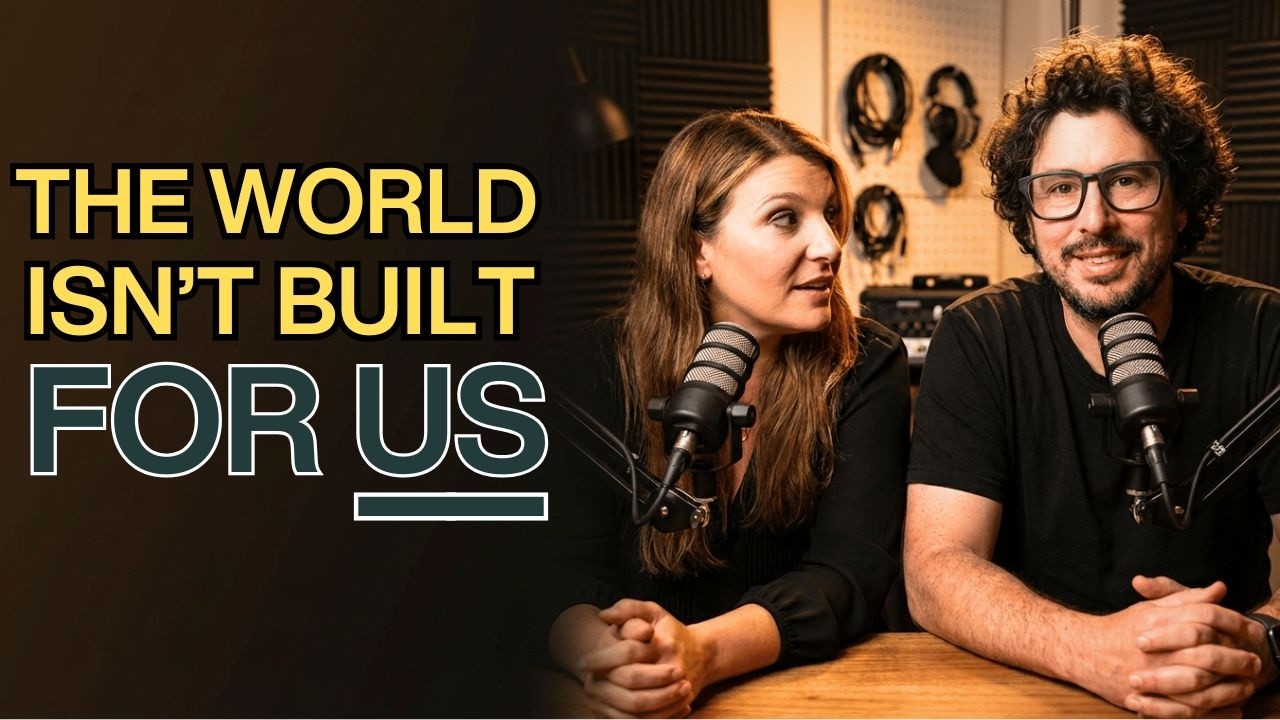
Episode 8 · Watch the conversation
A World That Wasn't Built for Everyone
15 min
Go deeper
Watch the full conversation on YouTube
A note on accuracy:While every effort has been made to ensure the information in this post is accurate at the time of writing, facts, policies and research can change. We're human, and sometimes we get things wrong. If you spot something that needs updating, we'd genuinely love to hear from you.

Dave Harrison
ESW · Neurodiversity Advocate · Podcast Host
Dave has spent 15+ years working in Australian classrooms as an Education Support Worker, with a background that also spans film school and film projects. He's the founder of THRVHUB, host of the Different Is Normal podcast and a passionate advocate for neurodivergent kids and the families who love them.
More about DaveComments
Sign in with GitHub to leave a comment. All comments are moderated through GitHub Discussions: respectful and on-topic only.